Skip to product information
1 of 6
4.8
Rated 4.8 out of 5 stars
109 Reviews

VMAGIC® Vaginal Suppository

10 count

A hormone-free vaginal suppository formulated with clinically tested hyaluronic acid to provide lasting moisture. Designed to help ease dryness-related discomfort and support everyday vaginal comfort.

Soothe Dryness
Support Comfortable Intimacy
Hormone Free
OBGYN Recommended
Subscribe & Save!
$ 33.99 $ 39.99 per pack
$ 31.99 $ 39.99 per pack
$ 29.99 $ 39.99 per pack
save 15%

1 Pack delivered every 1 month

  • 15% off for life
  • Pause, modify, or cancel anytime
  • Free US shipping on every order over $50
Most Popular!
save 20%

3 Pack delivered every 3 months

  • 20% off for life
  • Pause, modify, or cancel anytime
  • Free US shipping on every order over $50
Best Value!
save 25%

6 Pack delivered every 6 months

  • 25% off for life
  • Pause, modify, or cancel anytime
  • Free US shipping on every order over $50
One-time Purchase
$ 39.99 per pack
$ 36.79 $ 39.99 per pack
$ 35.19 $ 39.99 per pack

Risk-free for 30 days

How to Use

With clean hands, remove one suppository from the wrapper and gently insert it into the vagina as far as is comfortable. If the suppository has softened, place it in the refrigerator until it firms before use.
This may be done while lying on your back with knees bent.
Once inserted, the suppository will melt with body temperature. For best results, insert before bedtime and remain lying down for a short period to help minimize leakage.
Some discharge or leakage is normal and expected; use of a panty liner may be helpful. Use one suppository every 2–3 nights, or as needed. Do not use more than one suppository at a time.
For vaginal use only. Discontinue use if irritation occurs. Not intended to diagnose, treat, cure, or prevent any disease.


Ingredients

5mg Hyaluronic Acid per insert

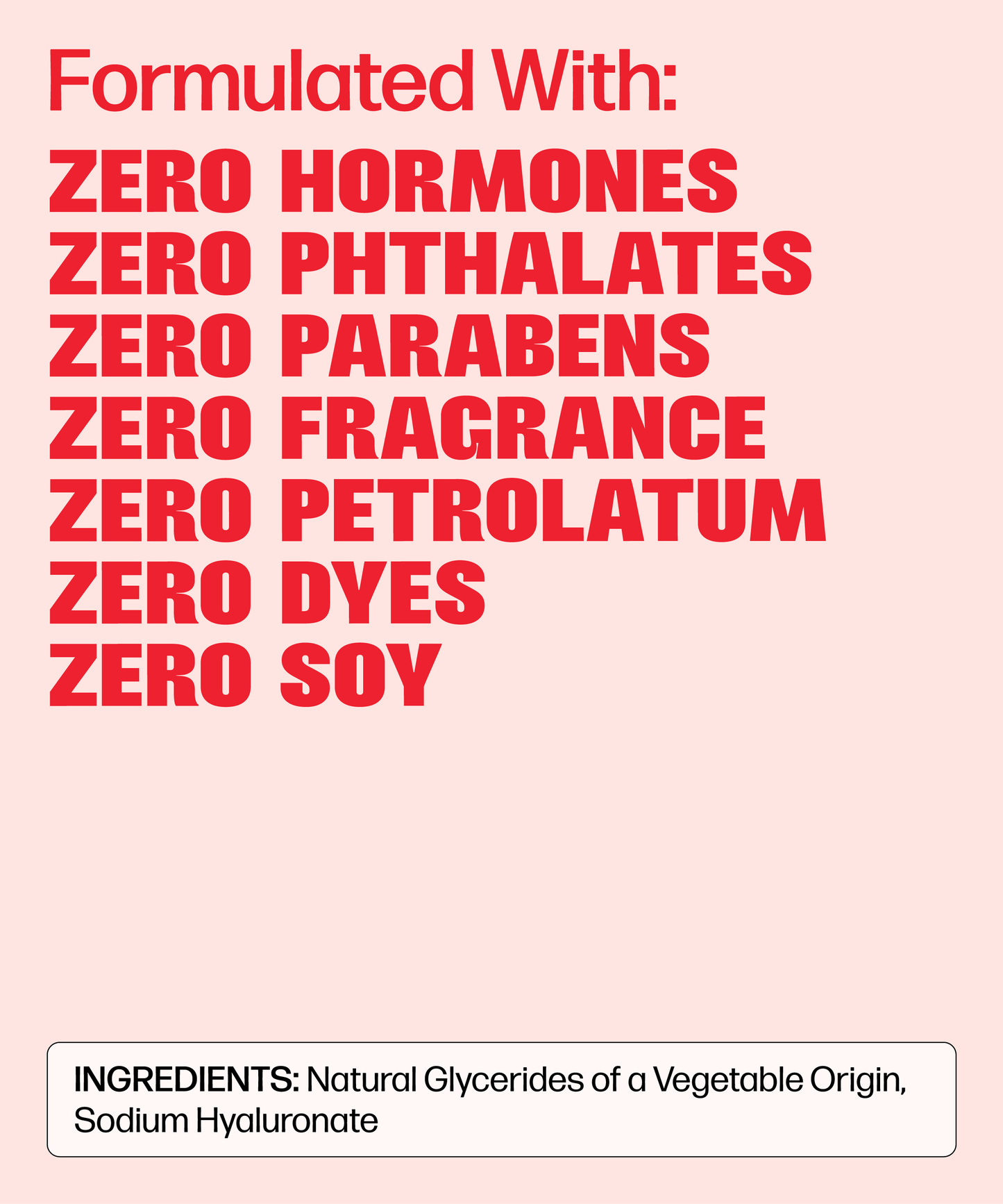
Ingredients: Natural Glycerides of a Vegetable Origin, Sodium Hyaluronate

Product Benefits & Trial Results

For vaginal use only. Discontinue use if irritation occurs. Not intended to diagnose, treat, cure, or prevent any disease

View full details

See The Magic

Hormone Free
OBGYN Recommended
Clinically Studied Ingredients
Hormone Free
OBGYN Recommended
Clinically Studied Ingredients
Hormone Free
OBGYN Recommended
Clinically Studied Ingredients
Hormone Free
OBGYN Recommended
Clinically Studied Ingredients

Q&A

Why does vaginal dryness happen during menopause?

Estrogen plays an important role in maintaining the thickness, elasticity, and natural lubrication of vaginal tissue. As estrogen levels decline or fluctuate during perimenopause and menopause, vaginal tissues may become:

  • Thinner
  • Less elastic
  • Drier
  • More sensitive

These changes are often part of a broader condition known as genitourinary syndrome of menopause. Symptoms can include vaginal dryness, discomfort during intimacy, irritation, and increased sensitivity.

Unlike the vulva, which is external skin, the vagina is an internal canal that maintains its own pH and microbial balance. However, hormonal changes can reduce natural moisture within the vaginal walls. This is where internal moisturizers, such as vaginal suppositories, may offer support.

What is a vaginal suppository?

A vaginal suppository is a small, solid insert designed to dissolve inside the vagina. Once inserted, it melts or dissolves, delivering moisturizing or soothing ingredients directly to the vaginal tissue.

Unlike lubricants, which are typically used during intimacy, a vaginal suppository is intended to provide longer-lasting hydration to vaginal tissue. Some suppositories are medication-based (such as prescription vaginal estrogen), while others are non-hormonal moisturizers designed to support comfort.

How does hyaluronic acid work in a vaginal suppository?

Hyaluronic acid is a naturally occurring substance in the body that helps retain moisture in skin and connective tissue.

In vaginal health products, hyaluronic acid works by:

  • Attracting and retaining water
  • Supporting tissue hydration
  • Improving elasticity
  • Reducing dryness-related discomfort

Because it is non-hormonal, hyaluronic acid can be an option for women who prefer to avoid estrogen-based treatments or who are not candidates for hormone therapy. When formulated as a vaginal suppository, hyaluronic acid is delivered directly to internal vaginal tissue, allowing for localized moisture support.

Is a vaginal suppository safe?

When properly formulated and used as directed, a vaginal suppository can be safe during menopause.

Here’s what makes one safer:

  • Free from fragrance
  • Free from harsh preservatives
  • Designed specifically for vaginal use
  • pH-balanced
  • Non-hormonal (if estrogen is not desired)

It’s important to distinguish between internal moisturizers and products that claim to “cleanse” the vagina. The vagina is self-cleaning and does not require internal washing. A vaginal suppository should support moisture, not disrupt the natural microbiome.

If you experience burning, unusual discharge, or a strong odor, consult a healthcare provider rather than self-treating.

What is the difference between a vaginal suppository and a vulva moisturizer?

It’s common to confuse internal dryness with external irritation. A vaginal suppository treats internal vaginal dryness. A vulva moisturizer treats dryness or irritation of the external vulvar skin.

Some women benefit from using both, addressing internal moisture and external comfort separately. Because the vagina is internal tissue and the vulva is external skin, each requires a different type of support.

Dr. Clare

#ASKMEDMAMA

Meet Dr. Clare Bertucio; mother, wife, physician of 20+ years, fierce women’s health advocate and now CEO. With Dr. Clare, no question is too bold or too taboo. She’s working to build a more informed, confident, and liberated female community. Join in the conversation, embrace your Vulva, and be a part of this revolutionary journey that Medicine Mama is leading. Go ahead #askmedmama.

Reviews

4.8
Rated 4.8 out of 5 stars
Based on 109 reviews
Rating
Ratings
109 reviews
  • Kim R.
    Verified Buyer
    Rated 4 out of 5 stars
    2 days ago
    So far, so good

    I just started using it. I'm hoping it will work well.

  • Catherine H.
    Verified Buyer
    Rated 5 out of 5 stars
    2 days ago
    Very nice

    This is a great product. Easy to use and helps with hydration!!!

  • Carrie L.
    Verified Buyer
    Rated 5 out of 5 stars
    2 days ago
    So helpful

    This helps relieve the dryness and itching from menopause.

  • Tracy P.
    Verified Buyer
    Rated 5 out of 5 stars
    2 days ago
    Feeling Sexy Again!!

    I want to thank your company for making me feel sexy, and helping all my lady bits feeling younger, softer, and moist again!! Sex is great again!! My partner and I are enjoying sex like we used too!!!

  • Karen M.
    Verified Buyer
    Rated 5 out of 5 stars
    3 days ago
    Switched from another brand to Medicine Mama

    I have used another brand of Vaginal Suppositories for about a year and was not really happy with it. Then i saw the Medicine Mama ad for the Vulva Balm and tried it. I loved it! I went on the Medicine Mama site and found that they offered the Vaginal Suppositories for dryness. I decided to give it a try! I not only love this brand but i also cancelled my subscription with the other company. I would recommend Medicine Mama to anyone looking for feminine products. I even took the products to my OB/GYN and showed them to her because she told me that her patients are always looking for good products that work. Medicine Mama steps up to the plate with great results!

  • ¹ Chen J et al. Hyaluronic acid vaginal gel trial. J Sex Med. 2013;10(6):1575-84.

  • ² Ilhan G et al. Hormonal vs nonhormonal agents for vulvovaginal atrophy. J Menopausal Med. 2021;27(1):15-23.

  • ³ Agrawal S et al. Vaginal hyaluronic acid vs estrogen for GSM. Menopause. 2024;31(9):750-5.

  • ⁴ Portman DJ, Gass ML; VVA Consensus Panel. Genitourinary syndrome of menopause terminology. Menopause. 2014;21(10):1063-8.

  • ⁵ Chen M et al. Hyaluronic acid vs estrogen for vaginal atrophy: meta-analysis. Arch Gynecol Obstet. 2021;303(3):631-44

1 of 5